Default
Application Spotlight: Dirac-3 Charts a Course Towards Bioengineering Advance Through the Twists and Turns of Folded Proteins
We all know protein is important. But it goes beyond shakes and nutrition – proteins are the building blocks of life, of our bodies, and different proteins can have vastly different effects on our lives. Proteins, at their core, are long chains of amino acids, but their magic happens when the long chain folds itself into specific configurations that allow them to perform different functions. While we are familiar with structural proteins like collagen and elastin, which make up skin, hair, and nails, there are also motor proteins like actin and myosin, which are involved in muscle contraction, and cell signaling proteins like antibodies, which play a key function in immune responses.
But on the flip side of this, proteins that aren’t folded properly can cause problems in the body. Prions are a category of infectious agent that, unlike viruses, bacteria, or parasites, contain no DNA, and yet can wreak devastating effects in the body as the misfolded protein causes other proteins to unravel and build up in the brain, causing neurodegenerative diseases like Mad Cow Disease. Misfolded protein buildup has also been implicated in the development of disorders like Alzheimer’s and amyloid lateral sclerosis (also known as Lou Gherig’s Disease).
All of this is to say that understanding how proteins fold is of vital importance in the study of biology and the engineering of biotechnology advances. Unfortunately, proteins are, by definition, complex structures, and can have hundreds of possible configurations for a single protein. Calculating optimal folding patterns quickly becomes a very difficult problem, which can tax even cutting-edge computing systems. QCi researchers, in collaboration with Dr. David Huggins, Executive Director of the Tri-Institutional Therapeutics Discovery Institute, recently published a paper in which they show how the Dirac-3 quantum optimization machine measures up against current state of the art in solving the protein folding problem.
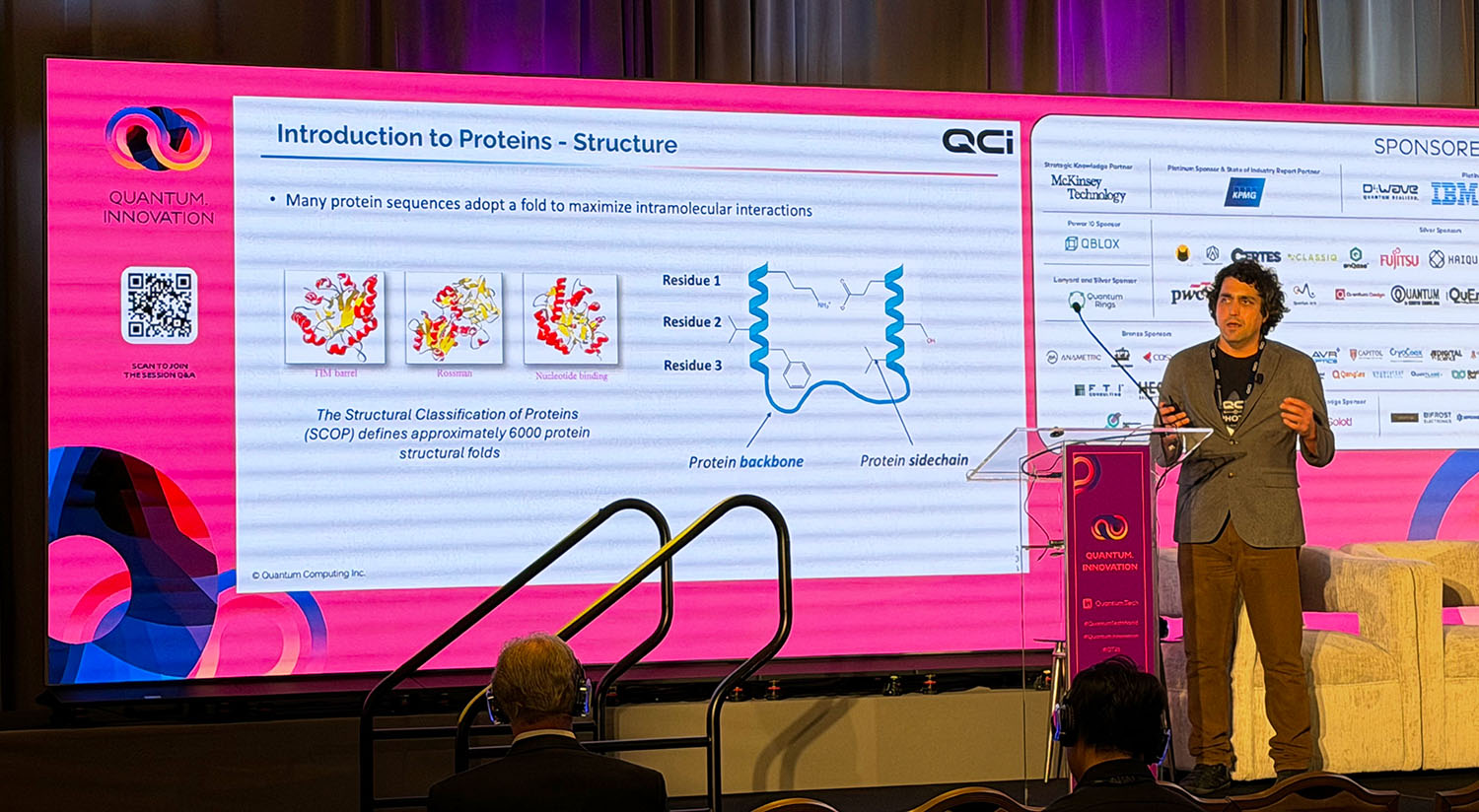
QCi Senior Quantum Data Scientist Dr. Babak Emami recently spoke on this work at Quantum.Tech World in Boston, MA, describing how Dirac-3 can enhance the field of bioengineering by making proteins problems easier to solve. "Bioengineering is emerging as one of the most exciting application domains for quantum computing,” says Dr. Emami. “Our protein-folding benchmarks on the Dirac-3 quantum optimization machine demonstrate how quantum technologies can be evaluated using real scientific workloads, bringing us closer to practical quantum advantages in protein engineering, drug discovery, and molecular design"
Researchers considered a standard protocol for solving the optimal configuration of a protein, fixed backbone computational protein design, which can be solved by classical computers, albeit slowly. Dirac-3 is designed to perform extremely well at solving complex optimization problems like the evolution of a structure towards its optimal configuration, so this problem translated easily to the quantum optimization machine’s entropy quantum computing protocol. Dirac-3 currently has the capabilities to consider problems with up to 949 variables, which makes it ideal for solving for the configurations of small to medium proteins, although future generations of the Dirac quantum optimization machine will rapidly be able to handle larger proteins.
You can read the paper for yourself at Scientific Reports, an open-access journal from the Nature Publishing Group.
Reference:
Babak Emami, et al., “Entropy quantum computing for fixed-backbone protein design.” Scientific Reports (2026). https://doi.org/10.1038/s41598-026-54101-2